Image as Part of Event Design
Short answer: Today, an image no longer holds attention on its own. Its real value appears when it becomes part of an event — shaping atmosphere, perception, and emotional experience.
Why an image alone is no longer enough
In the past, visual forms had a different weight.
Photography captured a moment.
Painting expressed a state.
Illustration reflected the author’s vision.
Today, images are created instantly and in endless quantities. They replace each other too quickly to be fully perceived. We rarely stop. We rarely stay inside an image.
Our attention has become too expensive, and the visual environment is overloaded. Because of this, an image no longer works effectively as a standalone object.
Where the real value of an image appears
The real strength of an image now reveals itself in context — within space, within an event, within a designed environment.
This is why illustration has naturally moved into event and space design.
Here, it is not something to look at separately. It becomes part of what is happening.
An image can:
- support the atmosphere of a competition;
- guide how the space is perceived;
- strengthen the character of the event;
- connect visual design with emotion.
My approach to images in rhythmic gymnastics events
I do not see an image as decoration.
For me, it is a way to shape perception.
An image becomes:
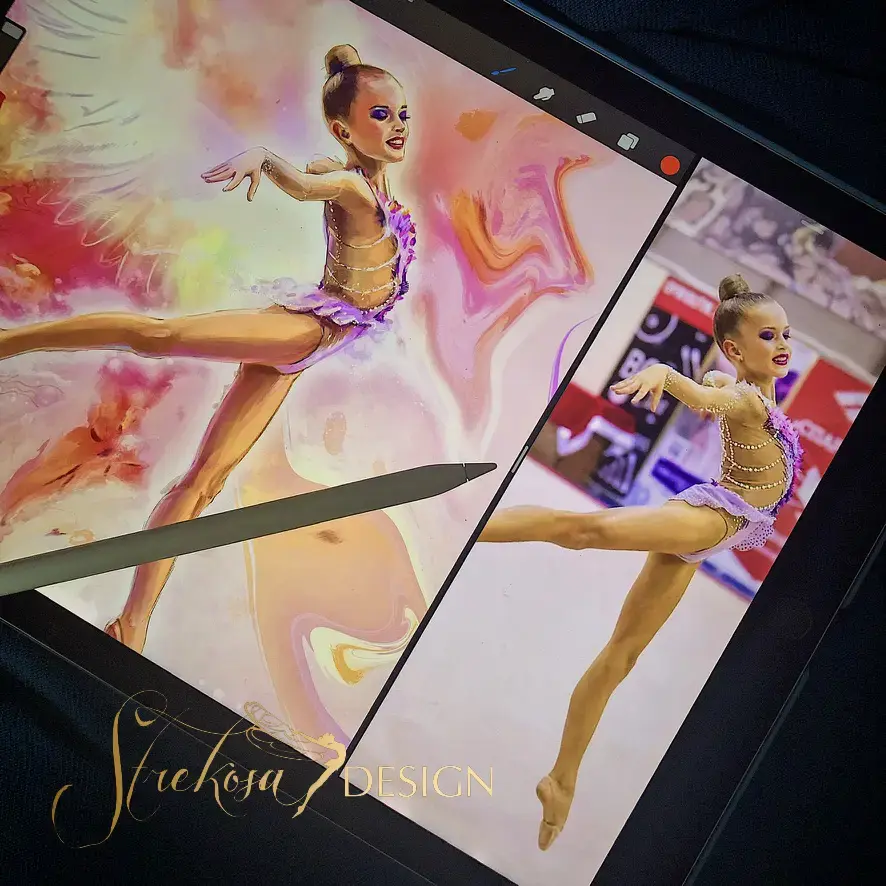
- a visual interpretation of the routine;
- a reflection of the competition’s character;
- a way to express rhythm, energy, and inner state.
It is not about showing something beautiful. It is about creating a visual environment that the viewer enters.
What a strong image actually does
A strong image does not stay on the surface.
It draws the viewer into the space of the event, where they are no longer just observing, but emotionally involved.
The viewer experiences:
- the competition itself;
- and the atmosphere created around it.
Conclusion
Today, an image is not a standalone object.
It is part of a system — space, light, movement, and emotion.
Its role is not only to be seen, but to make the event felt.
A Note for Organizers
For competition organizers, this changes the role of visual design completely.
It is no longer about adding decoration to a finished event. It is about building the visual layer of the experience from the beginning.
When images are developed as part of the event concept, they help create a stronger identity, a more memorable atmosphere, and a deeper emotional connection with the audience.
This is the approach I use in my work — designing images not as separate elements, but as part of the event itself.